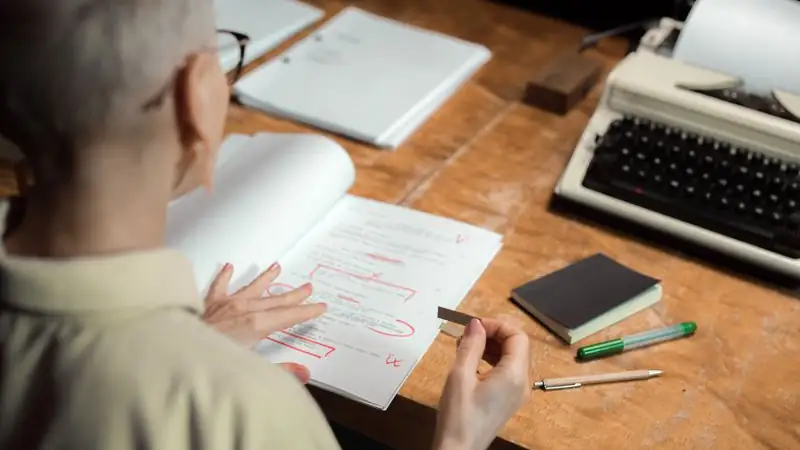
Research Proposal Example: Annotated Master's and PhD Sample
By Jessica McLaren 12 min read
A research proposal example is a filled-in proposal that shows what each section says, in what order, and roughly how long it runs. The annotated sample below uses the structure most UK PhD and master’s applications ask for (title, introduction, literature review, aims and research questions, methodology, timeline, references), and a full proposal built on it runs about 2,000 to 3,000 words, the range the University of Warwick’s Department of Sociology gives for a PhD proposal (Warwick Sociology).
Research proposal example, defined: a complete sample proposal for a study that has not happened yet, read to see how the problem, the gap in earlier research, the research questions and the method connect. Your own proposal keeps the moves and replaces every word.
The sample here is an illustration written for this guide. Every citation is a placeholder in the form (Author, Year) and it contains no findings or numbers, because a sample with invented studies teaches you to cite things that do not exist.
| Section | What the section does in the example | Typical length (Warwick Sociology PhD guide) |
|---|---|---|
| Title | Names the topic, the population and the setting | No length given |
| Introduction | States the problem and why it matters | About 200 to 300 words |
| Literature review | Shows what is known, where studies disagree and what is missing | About 500 to 600 words |
| Aims and research questions | Turns the gap into questions the study can answer | 400 to 500 words |
| Methodology | Explains how each question will be answered | 500 to 600 words |
| Conclusion | Restates the contribution | About 200 words |
| Timeline | Shows the project fits the degree | No length given |
| References | Lists every source cited | Not counted |
Warwick calls its 2,000 to 3,000 word total “only a guideline”. These are one UK department’s figures, not a universal rule, so check your own department’s page first.
What does a research proposal title and introduction look like?
A research proposal title names the topic, the people or cases studied, and the setting. The introduction states the problem in its first two sentences and says why it matters before giving any background.
Example (illustration, placeholder citations):
Title: Peer mentoring and first-year persistence among distance-learning students in South Africa
Introduction: First-year students at distance-learning universities study without daily contact with classmates, and many do not continue into their second year (Author, Year). Peer mentoring is widely offered as a response, yet most evaluations of peer mentoring come from campus-based universities in the United States and the United Kingdom (Author, Year; Author, Year). This study asks whether, and how, peer mentoring supports first-year persistence when students and mentors never share a campus.
Sentence one of the example introduction states the problem and who it affects. Sentence two names the usual solution and the limit of the evidence for it. Sentence three says what the study will do. Steal this pattern: problem, current response, limit of the evidence, what you will do.
What does the literature review section of a research proposal example include?
The literature review in a research proposal groups earlier studies by what they found, shows where those studies disagree or stop, and ends on the gap the proposed study will fill. The University of Sheffield’s Department of Politics and International Relations puts it plainly: “Literature reviews are not simply descriptive mapping exercises at PhD level” (Sheffield SPIR).
Example (illustration, placeholder citations):
Studies of peer mentoring at campus universities report that mentored students are more likely to continue their studies (Author, Year; Author, Year). These studies propose a social mechanism: mentoring builds belonging through regular face-to-face contact (Author, Year). Two strands of research complicate that account. Evaluations of online mentoring report weaker or mixed effects (Author, Year), and studies of distance learners suggest practical help with study routines matters more to them than belonging (Author, Year). None of the studies reviewed here followed distance-learning students in South Africa, and none compared the social and practical functions of mentoring in the same group.
The example literature review opens on the main finding, names the mechanism the proposed study will test, sets two strands of research against each other, and closes on a two-part gap: an unstudied population and an untested comparison. “None of the studies reviewed here” is a claim about your reading, so the review must show enough reading to carry it. See the literature review for a research proposal guide and research gap vs research problem.
What do aims and research questions look like in a research proposal example?
Aims and research questions follow directly from the gap: each research question answers one part of the gap, and the aim states what the whole study will achieve. In the example, a two-part gap produces one aim and three questions.
Example (illustration):
Aim: To explain how peer mentoring relates to first-year persistence among distance-learning students in South Africa.
Research questions:
- How do first-year distance-learning students describe what their peer mentors do for them?
- Which functions of peer mentoring (social, practical or both) do students link to their decision to continue?
- How do mentors’ and students’ accounts of mentoring differ?
In the example, question 2 tests the untested comparison in the gap (social versus practical functions of peer mentoring); questions 1 and 3 supply the description and a second perspective. All three use an open “how” or “which”, which suits a qualitative method. A “does X increase Y” question would commit the study to measurement and a comparison group. The research aims and objectives guide covers wording.
What does the methodology section of a research proposal example cover?
The methodology section of a research proposal explains the approach, the participants or sources, data collection and analysis, and ethics, in enough detail for a reader to judge that each research question can be answered. The University of Sussex Faculty of Social Sciences asks applicants to justify methodological choices, say specifically how participants or data will be accessed, and give a realistic timeline (Sussex).
Example (illustration):
The study will use semi-structured interviews, because the research questions ask how students and mentors understand mentoring rather than how much it changes outcomes. Participants will be first-year students from one distance-learning university’s peer mentoring programme, and their mentors, recruited through the programme’s coordinators once ethics approval is granted. Interviews will be analysed with reflexive thematic analysis (Author, Year), coding students’ accounts against the social and practical functions identified in the literature review. Participants will give informed consent, may withdraw at any point, and will be identified only by pseudonyms.
The example methodology justifies the design from the wording of the research questions, says who participants are and how they will be reached, names a method of analysis linked to the literature review, and covers ethics in one sentence. It gives no sample size; if your department expects one, state it with a reason and a methods source.
What does a research proposal timeline look like?
A research proposal timeline breaks the project into periods and shows each stage fitting inside the degree. Sheffield’s politics guide asks for a timetable covering three years, or three and a half on some scholarship routes (Sheffield SPIR); the Sussex Faculty of Media, Arts and Humanities asks for 6-month periods (Sussex).
| Period | Work |
|---|---|
| Months 1 to 6 | Extend the literature review; ethics application; agree access |
| Months 7 to 12 | Pilot interviews; revise the interview guide; begin recruitment |
| Months 13 to 24 | Interviews; transcription; first round of analysis |
| Months 25 to 30 | Complete analysis; draft findings chapters |
| Months 31 to 36 | Discussion and conclusion; revisions; submission |
A master’s timeline uses the same logic in months or weeks.
How long is a research proposal at different universities?
Research proposal length is set by the department, and UK departments ask for anything from about 500 words to about 4,000. Each figure below is from the department’s own page, read in November 2026.
| University and department | Level | Proposal length |
|---|---|---|
| University of Warwick, Sociology | PhD | Around 2,000 to 3,000 words |
| King’s College London, European and International Studies | PhD | 2,000 to 3,000 words, plus bibliography |
| University of Sheffield, Politics and International Relations | PhD | About 1,500 to 2,000 words |
| University of Sussex, Faculty of Social Sciences | PhD | 3,000 words, not including references |
| University of Sussex, Faculty of Science, Engineering and Medicine | PhD | 1,000 to 2,000 words |
| University of York, Computer Science | Research degree | About 500 to 1,000 words |
| University of York, Business and Society | Management PhD | Around 4,000 words |
| MIT, Electrical Engineering and Computer Science (CommLab) | SM or MEng thesis | About 8 to 12 pages |
| MIT, Electrical Engineering and Computer Science (CommLab) | PhD thesis | About 10 to 20 pages |
| USC Libraries research guide | General (US) | 10 to 35 pages, plus references |
Sources: Warwick, KCL, Sheffield, Sussex, York, MIT CommLab, USC Libraries. The free dissertation word limits tool collects more university figures.
How is a master’s research proposal example different from a PhD one?
A master’s research proposal is usually shorter and narrower than a PhD proposal, with fewer research questions, a smaller literature review and a timeline in weeks or months. MIT’s CommLab guide gives about 8 to 12 pages for an SM or MEng thesis proposal and 10 to 20 pages for a PhD proposal (MIT CommLab).
The bigger difference is the claim. A PhD proposal argues for an original contribution: Sheffield’s politics guide says the question “will need to be something that has not been posed before” (Sheffield SPIR). A master’s proposal needs a real gap and a project that fits the time allowed. To scale a PhD proposal on peer mentoring down to a master’s, keep the one research question that compares the social and practical functions of mentoring, fold the descriptive questions into it, and recruit from one cohort.
What does a research proposal look like in the US, UK and South Africa?
A research proposal in the US is usually a thesis or dissertation proposal measured in pages and approved by a committee; in the UK it is usually part of a PhD application and measured in words; in South Africa each faculty or department sets the length and sections.
United States. A master’s proposal is usually called a “thesis proposal” and a PhD proposal a “dissertation proposal”, approved by a committee; MIT’s CommLab calls it “a contract between you and your thesis committee” (MIT CommLab). US proposals are measured in pages.
United Kingdom. A UK PhD proposal is usually part of the application and measured in words. The University of York warns: “You won’t be able to edit your proposal after you’ve submitted your application” (York).
South Africa. Length and sections are set by each faculty or department. Stellenbosch University’s Faculty of Arts and Social Sciences says word counts “may vary from department to department” and requires, at a minimum, a working title, background and rationale, problem statement and research questions, theoretical points of departure, research design and methods, provisional chapter layout and timeframe, budget, and ethical considerations (Stellenbosch FASS, 2025). A Stellenbosch master’s proposal therefore needs a budget and a chapter layout, which many UK application proposals do not ask for.
Where can I find real research proposal examples from universities?
Some universities and methods textbook publishers publish real research proposal examples, worth reading next to an annotated sample. Each source below was checked on its own page in November 2026.
| Source | What it offers |
|---|---|
| York St John University | Four example research proposals (Word files) on its research degrees pages |
| SAGE, Creswell’s Research Design resources | Three sample proposals: quantitative master’s (Hayes, 2007), mixed methods doctoral (Ivankova, 2002), qualitative doctoral (Morales, 2006) |
| MIT CommLab | Two annotated MEng thesis proposals |
| Oxford Learning Link | Four example proposals with different methodologies, from How to do your Social Research Project or Dissertation |
| Edith Cowan University | A suggested proposal format with notes per heading (a template, not a student’s proposal) |
Read a published example for its moves, never its wording. Copying its sentences is plagiarism, and several University of York departments state that the proposal “must be in English and be your own words”.
How do I build my proposal’s gap paragraph with an AI assistant for writing backed by sources?
An AI assistant for writing backed by sources helps you build a proposal’s gap paragraph from papers you have already gathered: you ask where they agree and where they stop, then check your draft gap statement against them before your supervisor reads it.
Litrevu is an AI assistant for writing backed by sources. It reads every paper, report and PDF you add, answers your questions with a citation to the exact passage behind each claim, compares sources side by side, and checks your own draft against them.
For a gap paragraph on peer mentoring for distance-learning students, the Litrevu workflow on your own papers looks like this:
- Add your papers. Upload PDFs, paste DOI or arXiv links, or let Litrevu find open-access papers on your topic and pick the ones that fit.
- Ask where the evidence stops. Ask “Which populations and settings do these studies cover?” Answers cite only your papers, and Litrevu says when your papers do not cover a question.
- Open the citations. Each citation opens on its highlighted passage in the PDF, with title, authors and year.
- Compare the studies. Line them up side by side in a cited table (setting, population, method, finding) to see where they agree and differ. For the peer mentoring example, this is where a split between campus and online studies would show up.
- Check your gap statement. Paste your paragraph; each claim comes back Supported, Partly supported, Contradicted or Not in your papers.
| Claim from your draft | Result |
|---|---|
| “Most evaluations of peer mentoring come from campus-based universities (Author, Year).” | Supported |
| “None of the studies reviewed here followed distance-learning students in South Africa.” | Not in your papers |
“Not in your papers” means your library holds no study covering the claim, not that none exists. For a gap statement it is a cue to search wider, never proof of a gap. You decide which gap is worth a project and you write the proposal; Litrevu finds, lines up and checks the evidence in your papers.
Some universities limit AI use on proposals: the University of Sussex Business School says “AI may only be used in an assistive role in preparing your proposal” (Sussex). Check your university’s policy and declare your use with the free AI disclosure statement generator. The guide to using AI for a research proposal covers where the line sits.
Frequently asked questions
Can I copy a research proposal example?
No. You can copy the structure of a research proposal example, but not its wording, topic framing or citations. Copying a published proposal’s sentences is plagiarism, and several University of York departments state that the proposal must be in your own words.
What are the parts of a research proposal example?
A research proposal example usually has seven parts: title, introduction, literature review, aims and research questions, methodology, timeline and references. Some universities add more; Stellenbosch University’s Faculty of Arts and Social Sciences also requires a budget, a provisional chapter layout and ethical considerations.
How long should a PhD research proposal be?
A UK PhD research proposal is usually 1,500 to 3,000 words. The University of Warwick’s Sociology department and King’s College London’s European and International Studies department both give 2,000 to 3,000 words, while the University of Sheffield’s politics department gives about 1,500 to 2,000.
How long is a master’s research proposal?
A master’s research proposal is usually shorter than a PhD proposal, but the department sets the length. MIT’s CommLab guide gives about 8 to 12 pages for an SM or MEng thesis proposal, and Stellenbosch University’s Faculty of Arts and Social Sciences says word counts vary from department to department.
Where can I find a research proposal example PDF?
Real research proposal examples are published by York St John University (four examples), SAGE’s resources for Creswell’s Research Design (three sample proposals), MIT CommLab (two annotated MEng proposals) and Oxford Learning Link (four examples). Download them from the publishers’ own pages, not from file-sharing mirrors.
Should a research proposal be written in the future tense?
Yes, for the parts that describe your study. A research proposal describes work that has not happened yet, so the aims, methodology and timeline use “will”, while the literature review uses the past or present tense to report what earlier studies found.
What should I do after reading a research proposal example?
After reading a research proposal example, map its moves onto your own project: write your problem in one sentence, group the studies you have read by what they found, and state your gap in a sentence you can check against them. The step-by-step research proposal guide covers each section, and the research rationale guide covers the paragraph that argues why the study matters.
If you already have a folder of papers, you can line them up, see where they stop and check your gap statement against them in Litrevu. Add your papers and ask your first question. Free to start, no credit card required.